Planning a vow renewal ceremony differs from an actual wedding due to the changes in perspective, focus, and legal requirements. Whereas a wedding signals the beginning of a unified relationship and the legal constraints that come with it, a vow renewal is purely symbolic. Thus, it doesn’t have to be as extravagant as a traditional wedding.
That said, reaffirming those vows a second time can feel more exposed than the original wedding. Most people attending the vow renewal watched the first marriage happen, and were there for all its ups and downs.
History like that can be a blessing in disguise. A vow renewal ceremony can celebrate the journey since the original wedding. The move that demolished the budget, the health scares that changed everything, the children born from the marriage are all testaments to how far a couple has come since their original marriage. So planning the vow renewal ceremony should start from there.
A Vow Renewal Usually Doesn’t Require New Marriage Paperwork
A vow renewal is purely symbolic. It doesn’t create a new marriage. The couple is already married, so the person officiating a renewal isn’t bound by the legal rules of an actual marriage ceremony. All it takes is gathering friends and family at a venue and exchanging vows again. Couples planning a symbolic ceremony can focus on what they want to say and who they want involved.
The state of New Jersey, in particular, does have an optional process for couples who want the state involved. The Department of Health calls it a remarriage, and already-married couples can use it to formally reaffirm their relationship or vows.
The remarriage process requires proof of the existing marriage and the same $28 application fee used for a marriage license. Unlike an original New Jersey marriage license, a remarriage does not have a 72-hour waiting period. Couples who specifically want a registered New Jersey remarriage should handle that paperwork through the appropriate local registrar.
Sample Vow Renewal Ceremony Order
A purely symbolic renewal doesn’t require any script for the ceremony. It’s relieving to hear, but doesn’t provide any direction on what’s supposed to happen. The world is your oyster, as long as you’re not paralyzed by choice.
BCP Council, an English local authority that conducts formal renewal ceremonies, provides some good examples of what to include: a welcome, readings, renewed vows, rings, family involvement, and a closing. A ceremony like this should run about 20 to 30 minutes, a happy medium for how much a renewal can fit without becoming a full-blown wedding ceremony.
A family-centered version can follow this order:
- Welcome everyone and explain why the couple chose to renew now.
- Share one short part of the marriage story.
- Invite a child, grandchild, old friend, or member of the original wedding party to read or speak.
- Exchange the renewed vows.
- Bless the existing rings, exchange new bands, or add an anniversary engraving if the couple wants to.
- Close by presenting the couple and, if desired, signing a keepsake certificate.
If the ceremony needs to be shorter, cut the reading before cutting the vows. Those vows are the most important part, the reason everyone came.
1. Let the Person Leading the Ceremony Explain Why Today Matters
The best person to lead a vow renewal is not necessarily a professional officiant, but someone who can stand in front of the room and understand why the couple is there.
The original officiant may still be part of the couple’s life. A member of the clergy makes sense when the renewal includes a religious blessing. An old friend may remember the first wedding better than anyone else in the room.
A grown child brings a different point of view. They have watched the marriage from the inside, arguments included.
Whoever leads should know why the couple is renewing their vows before writing the opening. A 25th anniversary, recovering from a difficult stretch, finally celebrating with relatives who missed the original ceremony, and simply wanting the whole family together lead to very different openings.
2. Give the Family One Real Part of the Ceremony
Children and grandchildren do not need honorary titles just to be included. Give them something specific to do.
A grown child can tell a two-minute story about the marriage they grew up around. A grandchild can read a poem. Someone from the original wedding party might read a letter from the first wedding or tell the story of something that went wrong that day and became funny twenty years later.
The roles that work for children at a wedding translate naturally to a renewal, but the relationship has changed. These children are living parts of the history the couple is celebrating.
Not every family member needs a role. One good reading is much better than five different jobs created just for the sake of including everyone.
3. Write Vows About What Actually Happened
Renewal vows have one advantage over wedding vows: evidence.
You can talk about the cross-country move, the year one partner was sick, the business that failed before the next one worked, or the ordinary Sunday ritual that somehow lasted twenty years.
Some couples begin by reading one or two lines from their original vows. Then they answer those promises from where they stand now. A line about supporting each other’s dreams can hit much harder after the trials and tribulations of raising children, changing careers, caring for parents, or retiring together.
The same basic structure used for writing your own wedding vows still helps: start with a real memory, say what your partner has changed in you, and make a few promises about what comes next.
4. Decide What the Rings Mean This Time
There’s no need to exchange rings again. Like most other aspects, it’s entirely up to the couple’s discretion.
Some couples simply hold hands while repeating their vows. Others have their existing bands blessed, add an anniversary band, or engrave the renewal date inside rings they already wear.
If a new ring is part of the ceremony, the officiant can explain why before handing it over. That makes the moment about the marriage instead of the jewelry.
An engraving can etch some memory from the time between the wedding and the vow renewal, such as a date, a place, a family phrase, or a few words the couple has actually used during the marriage.
5. End Without Pretending You’re Getting Married Again
The ending should sound like a renewal. Renewals don’t normally include legal jargon.
There’s no need to pronounce the couple married again. The person leading the ceremony can say something as simple as, “I present to you, still choosing each other after 30 years.”
A keepsake certificate can follow if the couple wants one. For a symbolic ceremony, it is exactly that, a keepsake. If the couple chose New Jersey’s formal remarriage process instead, the state paperwork is a separate legal step and should be handled according to the registrar’s instructions.
Then the music starts and everyone can stop sitting quietly.
What Happens After the Vows Can Be Much Looser
A renewal reception does not need a first dance, bouquet toss, cake cutting, introductions, and every other part of a traditional wedding timeline. Unless, of course, the couple still wants them.
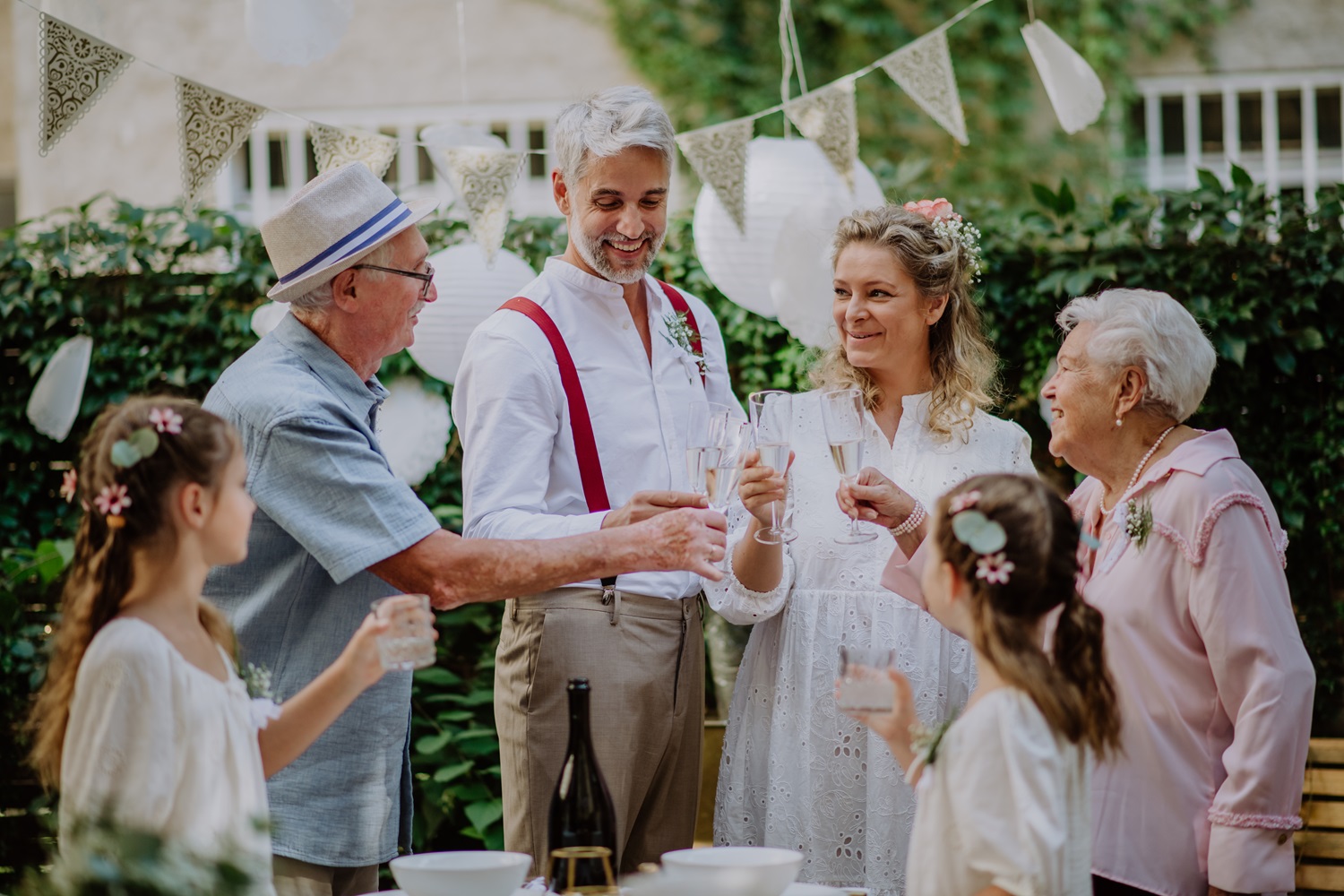
The evening can work more like an anniversary party. Give grown children and old friends time for toasts. Put wedding photos from different decades around the room. Let the grandchildren discover the dance floor on their own.
Attire has the same freedom. An original wedding dress can come back altered or restyled, but it doesn’t need to. The couple can wear whatever fits the celebration they are planning now.
The useful venue questions are practical ones: How many people can sit comfortably for the ceremony? Can guests move into dinner without leaving the property? Is there room and audio support for a slideshow or video? What food-and-beverage minimum applies, and how late can the party run?
Those are the same kinds of details worth checking when choosing a milestone party venue. Guest count changes the room, menu, staffing, and budget much faster than the ceremony script does.
Questions Couples Ask Before Planning a Vow Renewal
Can a couple renew their vows without guests?
Yes.
A couple can exchange vows privately on the anniversary itself with nobody else there. Some bring a photographer or ask one family member to witness it. Others keep the ceremony private and throw a larger anniversary party later.
Privacy changes the vows too. Without an audience, people sometimes say things they would never try to fit into a microphone in front of 150 relatives.
How much does a vow renewal cost?
There is no reliable national average specifically for vow renewals because the term covers everything from two people exchanging vows at home to a fully catered ballroom event.
At the simplest end, a symbolic ceremony at home with a friend leading it may have no venue or license cost at all. If a New Jersey couple chooses the state’s optional remarriage process, the current application fee is $28.
Once a venue, catering, photography, flowers, entertainment, or other vendors are added, the budget begins to resemble other private celebrations. For scale, The Knot’s 2026 Real Weddings Study found that U.S. weddings with 1 to 50 guests averaged about $17,100, while its average for New Jersey weddings was $57,000.
These are just general averages, not guaranteed price tags. A renewal may cost far less because the couple can skip anything that does not matter to them. The useful budgeting question is how many guests are coming and which parts of a wedding-style celebration the couple actually wants to buy.
Do guests bring gifts to a vow renewal?
A gift usually is not expected in the same way it might be for a first wedding. The couple is not setting up a household.
If they would rather guests arrive empty-handed, the invitation can make that easy: “Your company is the only gift we’re hoping for.”
Another option is to name a charity the couple supports. A handwritten card with a memory from the marriage can also mean more than another household item after twenty or thirty years together.
How long should a vow renewal ceremony be?
About 20 to 30 minutes is enough for a welcome, one story or reading, the vows, an optional ring moment, and a close.
A private renewal may be much shorter. A religious service or ceremony with several family readings can run longer.
The test is not whether the ceremony matches a wedding’s length. It is whether every person speaking has something that belongs there.
Start With One Page, Not a Vendor List
Before booking anything, make one page for the ceremony.
Write down why the renewal is happening now, who should lead it, the people who genuinely need a role, and three moments from the marriage that might belong in the vows.
That page is enough to start the conversation with an officiant, venue, photographer, or family member. The rest of the celebration can grow around it.
Sources
New Jersey Department of Health, Marriage License and Remarriage Guidance