
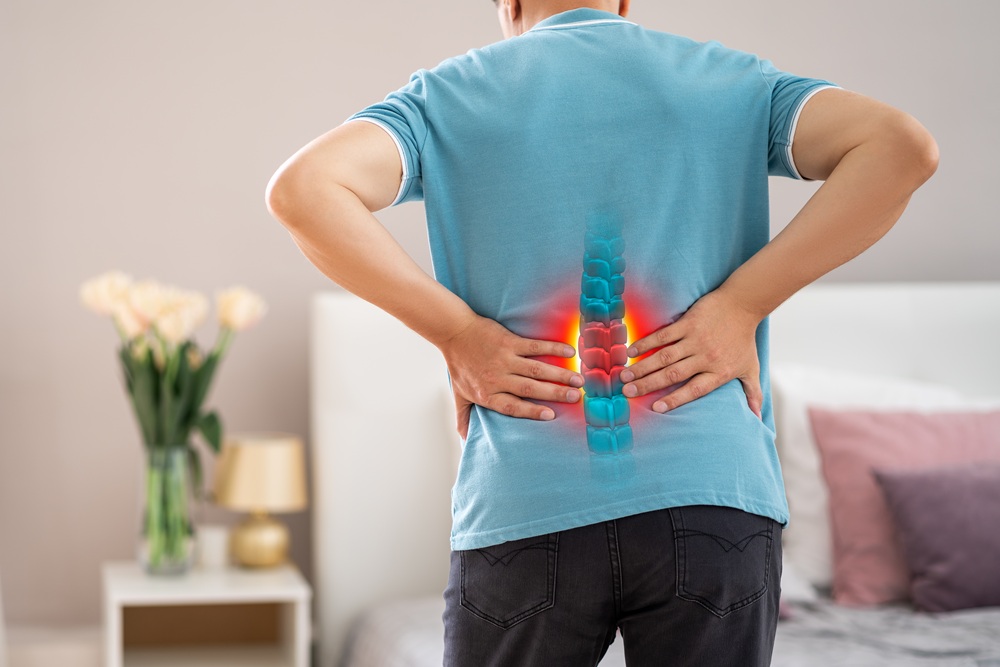
If you have just been told you have a herniated disc, the first question is almost always the same: can a herniated disc heal on its own, or is surgery unavoidable? In most cases, the answer is that it can. What that process looks like, how long it takes, and what speeds things up often go unexplained. Here is what the evidence shows about natural recovery, what helps, and when waiting stops being the right choice.
What Does It Mean When a Disc Herniates
The spine runs on a stack of bones called vertebrae, with cushioning discs between each one. Each disc has a tough outer ring and a soft, gel-like center. When that outer ring weakens or tears, the inner material can push through and press against nearby nerves. That pressure is what produces the pain, numbness, and radiating discomfort.
Doctors sometimes call this a slipped disc or a ruptured disc. Herniated discs rank among the most common back pain treatment options spine specialists evaluate, affecting millions of adults each year. Lower back herniation is the most common type, though cervical herniation in the neck occurs frequently as well.
The Difference Between a Bulging and Herniated Disc
These two terms describe different things. A bulging disc means the outer ring has weakened and expanded outward without tearing, like a tire low on air. A herniated disc means the outer layer has torn and the inner material is pushing through that break. Both cause pain, but herniated discs press more directly on nerve roots, which produces sharper nerve-related symptoms.
Bulging discs change more slowly and are often more stable. Herniated discs can be sharply painful at onset, but the body’s immune response engages more aggressively with them once they rupture.
Can a Herniated Disc Heal on Its Own
Can a herniated disc heal on its own? Yes, in most cases. Around 90 percent of patients with herniated disc symptoms see real improvement without surgery.
According to a 2015 study in Medicine by Chiu et al., natural shrinkage occurs through the body’s immune response. The immune system identifies extruded material as out of place and gradually breaks it down. This reduces pressure on the surrounding nerve roots. The disc rarely returns to its original shape, but symptoms often resolve as that pressure lifts.
Recovery does not mean ignoring what the body is reporting. Even when progress is improving, the warning signs that back pain has become an emergency are worth recognizing. Some symptoms need immediate attention even when the overall direction is good.
What Happens When a Herniated Disc Can Heal on Its Own
Long-term patient studies have found a counterintuitive result: larger herniations often show more complete natural breakdown than smaller ones. A bigger extrusion exposes more disc material to the immune system, which then mounts a stronger response. Smaller contained herniations can produce ongoing inflammation without triggering the same degree of breakdown.
Most improvement happens in the first 6 to 12 weeks. After that window, a patient without meaningful progress is less likely to resolve without some form of intervention. Most clinicians treat that three-month point as the moment to reassess and move toward intervention if progress has stalled.
Factors That Affect How Well a Herniated Disc Heals
Age is a factor. Younger discs hold more moisture and surrounding tissue repairs more readily. Herniation size and location both affect recovery pace, as does whether nerve compression is severe. Beginning movement early produces better results than full bed rest, because the disc relies on gentle loading to maintain circulation and support the healing process.
Smoking slows disc healing by restricting blood supply to spinal structures. Excess body weight keeps lumbar discs under load throughout the day, which sustains pressure even as symptoms improve. Addressing both during recovery is not optional if the goal is lasting recovery.
What Helps a Herniated Disc Heal Without Surgery
Clinical thinking has moved firmly away from immobilization over the past two decades. Staying gently active, within pain tolerance, produces better outcomes than extended bed rest. Anti-inflammatory medications help manage the acute phase but do not speed the natural healing process on their own. Guided movement, physical therapy, and targeted treatment to calm the nerve response form the foundation of non-surgical recovery.
For patients whose pain is too severe for physical therapy to be effective, epidural steroid injections can reduce nerve root inflammation and open a window for movement-based recovery. What they do is reduce inflammation enough that patients in the acute phase can begin engaging with physical rehabilitation.
Can a Herniated Disc Heal on Its Own With Physical Therapy
Can a herniated disc heal on its own with physical therapy as the primary tool? In most cases, yes. Physical therapy has the strongest evidence base of any conservative approach for herniated disc recovery. Specific techniques, including the McKenzie method, nerve gliding, and core stabilization, reduce pressure on the affected nerve and support the body’s healing process. Patients who follow a structured program usually report real improvement within 4 to 8 weeks.
When standard physical therapy has not produced results, options such as platelet-rich plasma or prolotherapy address the disc and surrounding tissue at a cellular level. These options sit between conventional physical therapy and surgery, and they are more accessible than people often realize when the standard PT route has stopped producing gains.
When Conservative Care Is Not Enough
When symptoms have not improved after 6 to 12 weeks of consistent conservative care, or when they are getting worse, a closer assessment is needed. Rest-and-PT and surgery are further apart than they usually appear, with considerably more options in that range than a patient first expects. Nerve blocks, radiofrequency ablation, spinal cord stimulation, and other interventions can restore function without an operating room.
Waiting too long when symptoms are worsening allows nerve damage to become more established and harder to address. An honest assessment at the six-to-twelve week mark gives the nerve a better chance of full recovery than continued waiting.
Can a Herniated Disc Heal on Its Own: Signs It Is Working
Recovery from a herniated disc is rarely a straight line, but consistent patterns show when things are moving in the right direction. Pain that decreases in frequency and intensity, even if still present daily, is a reliable marker. When arm or leg symptoms that were radiating outward begin retreating toward the spine, clinicians call this centralization. Centralization is one of the clearest indicators that nerve pressure is easing.
Better sleep, reduced reliance on pain medication, and more tolerance for walking all reflect genuine progress. Occasional bad days during an otherwise improving recovery are normal and do not mean the healing has reversed.
When a Herniated Disc Will Not Heal on Its Own
A herniated disc will not resolve on its own when pain intensifies steadily past the first 4 to 6 weeks rather than plateauing. Progressive weakness in a limb, or numbness that continues spreading rather than retreating, also indicates that the nerve is under increasing compression rather than recovering. Those patterns are a signal to get assessed, not to wait another few weeks.
Platelet-rich plasma, prolotherapy, and other regenerative medicine approaches offer a structured option between physical therapy and surgery when conservative treatment has stalled. Loss of bladder or bowel control alongside back or leg pain is a different situation entirely. That is cauda equina syndrome, a medical emergency. It requires surgical assessment immediately.
Questions Patients Ask Before Their Next Appointment
Can a herniated disc heal on its own, and how long does that take?
Real improvement typically arrives within 6 to 12 weeks of consistent conservative care. Complete resolution can take up to 6 months in more severe cases. One thing that often surprises patients: research shows larger herniations resolve more completely than smaller ones, because the immune system responds more aggressively to a larger extrusion. Recovery time also depends on herniation size and location, age, and how early movement is introduced.
Can you make a herniated disc worse by exercising?
High-impact activity, heavy lifting, and uneven spinal loading can aggravate an acute herniation. Gentle, guided movement is different and is generally beneficial. Walking, swimming, and exercises designed for disc recovery support circulation and reduce nerve inflammation. The issue is returning to pre-injury activity levels before the disc has had time to stabilize, not movement itself.
Is it safe to go to work with a herniated disc?
For desk workers and others in low-demand roles, returning to work soon after diagnosis is often possible and is compatible with recovery. For jobs involving heavy lifting or sustained bending, modified duties during the acute phase may be necessary. What is appropriate depends on the specific herniation and current symptom profile, which varies enough that guessing typically slows recovery rather than helps it.
Can a Herniated Disc Heal on Its Own: What This Means for Your Recovery
Can a herniated disc heal on its own? In most cases, yes. The body has a genuine capacity to break down herniated disc material over time.
Active conservative care, centered on movement and physical therapy, produces better outcomes than extended rest. When symptoms are severe, stalled, or worsening, the options between standard physical therapy and surgery are broader than they initially appear. Getting that assessment when progress has stopped, rather than waiting another month, is what gives the nerve the best chance of recovering fully.
Sources
Chiu CC, et al. The probability of spontaneous regression of lumbar herniated disc. Medicine, 2015.
Komori H, et al. The natural history of herniated nucleus pulposus with radiculopathy. Spine, 1996.